
Ice cream challenges met head on
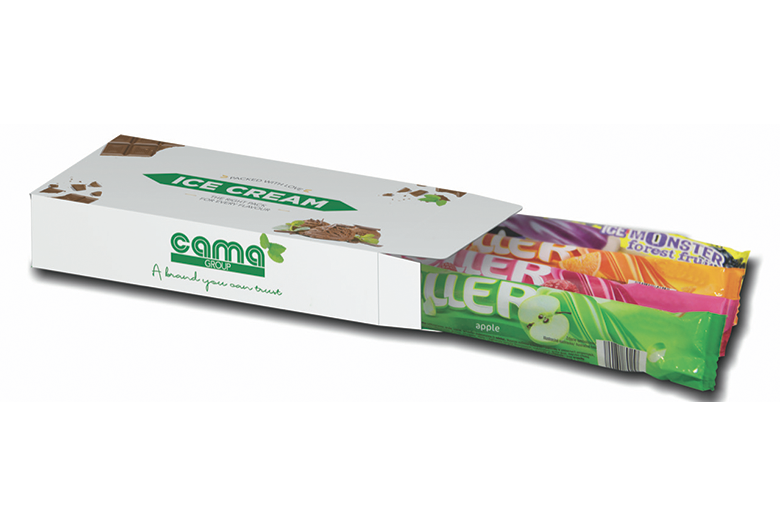
The seasonal and cyclical nature of the ice cream and frozen treat industry sets a singular array of challenges for its secondary packaging companies, a set of challenges that only grow due to evolving dietary trends, products and marketing campaigns.
It’s a market that is heavily dependent on brand and packaging appeal. As a result, manufacturers of these treats require gentle yet fast, flexible packaging technology, capable of handling an array of formats (flow wraps, cups, cones, sticks, etc.) that is able to keep pace with ever changing demands and styles; and protect and present the products to consumers using traditional and sustainable materials in the most effective and appealing way possible. Add into this the temperatures in which these machines need to work, and it is clear to see that this is no ordinary challenge.
Cama Group is a regular secondary-packaging machine supplier to the frozen treat/ice cream industry. Its machine and packaging formats, backed by digital automation and in-house designed robotic solutions – developed specifically for secondary packaging operations – means that the global Italian company has a solution that will match many end-user needs.
For example, a Polish frozen treat manufacturer, which specialises in private-brand products for retailers, recently utilised Cama’s expertise. The primary rationale behind the need for automated secondary packaging, was to boost and maintain speed and throughput by removing the company’s dependence on seasonal labour. With eight operators working in a three-shift pattern, potential efficiency and speed improvements were tangible.
The company also wanted to save materials, as the cartons had originally been designed for manual loading. Not only were they more complicated, but they also required specialist handling. By automating the process, Cama’s machines removed the need for this specialist packaging design.
Alessandro Rocca, sales engineering director, at Cama Group, states: “This is not the first time we have delivered a machine to a chilled washdown application; indeed, our machines are designed for multi-environment applications, and feature easy open, cleanable frames and no trap points. We have a range of machines that can fulfil the packaging needs but being able to mix and match our solutions to best fit the customer’s needs is definitely a powerful and desirable capability.”
For this application, the core of the solution is the primary controllers – in this case Allen-Bradley GuardLogix and CompactLogix PLCs – and the way they interface, not just with the customer’s management software, but also with the machine’s own onboard packaging-recipe-control and the tightly integrated robot controller.
“The customer needed maximum flexibility from our machines in order to address a wide array of packaging formats.” Rocca explains, “We had to cater for 13 different packaging arrays, which encompassed multi flavours, in multi layers, comprising 4, 5, 6, 8, 9, 12 or 20 product counts. Each format is sideloaded into a pre-glued carton which is then closed with hotmelt.”
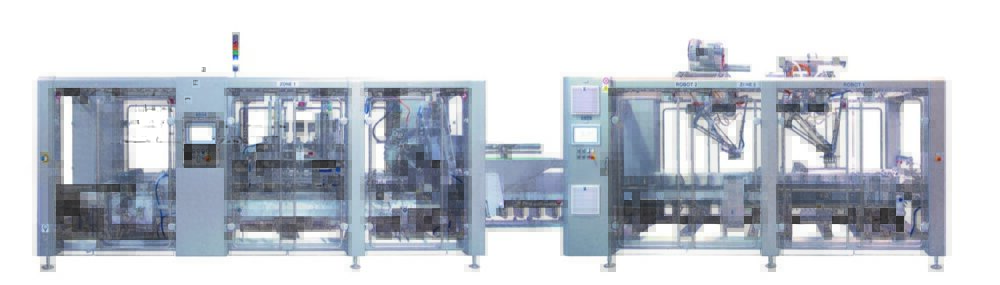
The solution supplied by Cama, comprising an IT280 robotic loading machine and a CL169 continuous-motion cartoning machine, is fed by four lanes, after which the products are spaced using accelerating conveyors. Each product is then placed into an intermittently moving pocket conveyor and, when collated, is picked up by a delta robot and loaded into a bucket conveyor. The electronic cartoning machine then sideloads the products into the cartons, which are next transferred to a flap-folding station, closed by hot-melt and then conveyed to the machine’s outfeed.
Both machines are part of Cama’s Breakthrough Generation (BTG), which means they have design and operational features offerings modular, scalable and hygienically designed frameworks to house contemporary automation solutions – including advanced rotary and linear servo technology – which can be tightly coupled to in-house-developed robotics, to deliver flexibility and adaptability required by modern packaging operations. The machine range is also based on a digital platform that supports full Industry 4.0 capabilities, including AR, VR and virtual testing, training and operation.
“We have a very close understanding as to how manufacturers are affected by consumer choices, and how they need to adapt – often very quickly – in order to satisfy quickly changing market trends,” Rocca concludes. “Our BTG range, with its multi-application, multi-environment capabilities was designed specifically to address these needs. Thanks to its electronic backbone, it is also fully Industry 4.0 compatible, a capability that has been exploited extensively during the pandemic, where we have been able to undertake a huge array of remote operations and interactions, including full FATs. These capabilities are set to stay commonplace as many end users begin to realise the outstanding capabilities that data-capable machines can deliver.”
