Klevertec develops new pasteurisation techniques
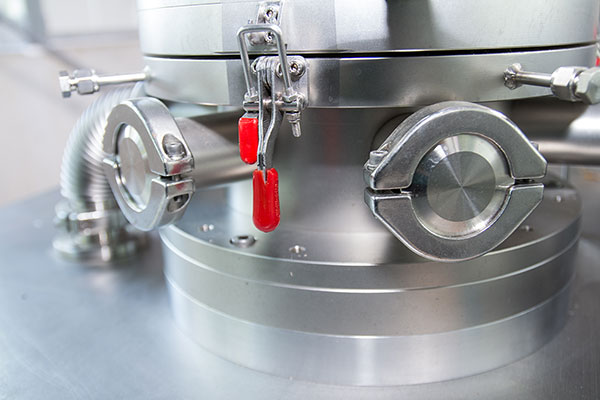
The industrial pasteurisation of viscous foodstuffs with piece fractions is usually carried out in a time consuming and energy intensive batch process in stirred kettles. However, German company Klevertec is developing new processes. The liquid foods with lumpy particles are heated more quickly and more evenly in high frequency heating tubes.
A transition to energy saving continuous heating in tubular heat exchangers requires a relatively large pipe diameter and long pipe sections with a long residence time because of the high viscosity and piece fractions. This is the only way to allow the heat to penetrate from the heated surface to the core of the pieces.
Penetrating heating methods can provide a remedy, by generating the heat by means of electric fields in the food itself. Klevertec is testing electrical methods, via high-frequency heating with working frequencies of 13 MHz or 27 MHz. The penetration depths are high compared to the microwave heating and are sufficient to uniformly enter power even in large pipe cross sections.
In the case of high-frequency heating, the direct galvanic contact between electrodes and foodstuffs, such as is used in so-called ohmic heating, is not necessary. This precludes electrochemical reactions and electrode corrosion.
In its project the company is looking at a replacement of glass in first prototypes by splinter-resistant plastic. It is searching for temperature distribution improvement in the pipe cross section as well as a fast and accurate control of the outlet temperature.
The new high frequency heating tube is integrated into a test facility, which comprises the product stream from mixing to cooling and collection in a buffer tank and allows initial application attempts. Possible applications for the heating tube are, for example, cheese preparations or sauces.
In existing prototypes, heating rates of up to 5 K/s have been achieved in a 50mm diameter pipe. Particles in the product stream simultaneously heat up with the liquid and leave the heater tube at approximately the same temperature as the surrounding liquid.
Thermal product damage can be minimised by very short heating times in the order of less than one minute. In addition colour, aromas, vitamins and structure can be better preserved than in conventional tube heat exchangers.
Topics