

Smart control valve for flow rates at PPMA
Credit: Schubert & Salzer
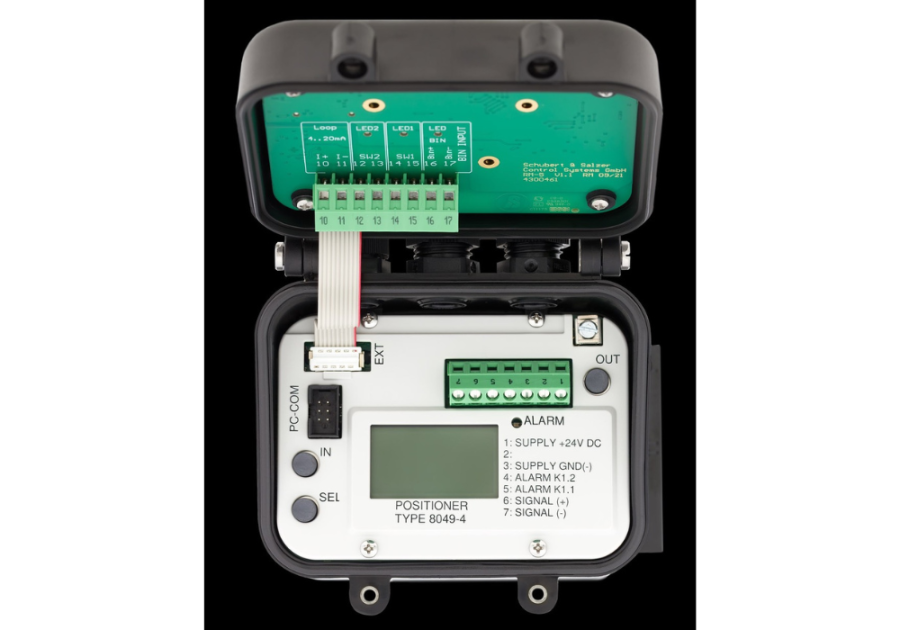
At PPMA on stand G70, Schubert & Salzer is presenting a low flow valve type 7042 for minimal flow rates and high-pressure applications. Equipped with the top-mounted positioner type 8049, the valve type or needle valves are always used wherever minimal flow rates or high pressures have to be controlled with particular precision or securely shut off. With the type 7042, Schubert & Salzer developed a low flow valve that not only offers minimal Kv-values of 0.0027 to 1.3 and a nominal pressure of PN320, but also state-of-the-art field integration.
The low flow valve type 7042 works together with the integrated positioner type 8049. In addition to an explosion-protected and FM version, it can also be equipped with an IO-Link connection. With IO-link, a single cable with an M12 plug bundles the positioning signal, position feedback, data transmission and even the power supply. The continuous monitoring of the status data allows even the slightest irregularities in the control behaviour to be detected. The evaluation of the data facilitates the planning of predictive maintenance and thus increases process reliability and plant availability.
A further advantage of the type 7042 is the top-mounted installation of the integrated positioner. The design enables the fast and uncomplicated replacement of the control unit and is thus particularly maintenance-friendly. The new positioner is automatically configured with the parameters of the predecessor via IO-Link. It is immediately ready to operate following a brief self-calibration routine.
The low flow valve type 7042 has a valve body made of stainless steel barstock material, a metallically sealing, replaceable trim made of hardened stainless steel or carbide to reach maximum reliability and a long service life even in high-pressure applications. Due to a special high-pressure packing, high leak-tightness is achieved even with a high switching frequency.

