Salt still too high in cheese, says action group
Salt levels in cheese are high with large variation between different types of cheese and within the same type of cheese, according to a new paper by Consensus Action on Salt and Health (CASH), published in the BMJ (British Medical Journal) Open.
“Cheese is one of the ten biggest contributors of salt to the UK diet, with cheddar and cheddar-style cheese being the most popular, so lowering their salt content would make a real difference to our salt intakes,” according to the group. “On average, salt content was significantly higher in branded (1.78g per 100g) cheddar and cheddar-style cheese compared to supermarket own-label products (1.72g per 100g). This demonstrates that it is technically possible to produce cheese with less salt in it.”
The survey also looked at the salt reduction targets for ten types of commonly consumed cheese, which were set by the Food Standards Agency and implemented by the Department of Health, to be achieved by 2012. Cheese types that have salt reduction targets had significantly less salt than those that do not have targets 1.66g per 100g versus 1.78g per 100g. While 85% (333 of the 394) of cheeses have already met their targets, 81% (318 of 394) would still get a red (high) colour coded rating for salt, the study says. “Disappointingly, the majority of branded cheese companies, unlike retailers, have not even signed up to the Department of Health¹s salt reduction programme,” CASH reports.
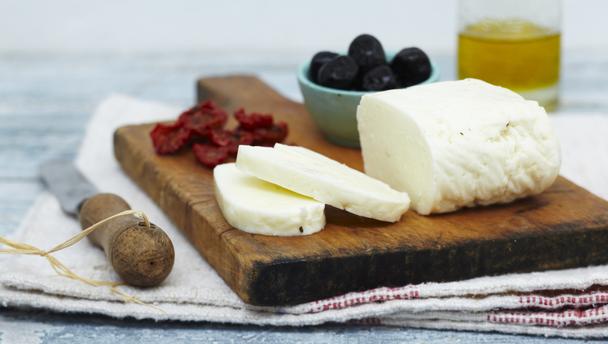
On average, halloumi and imported blue cheese (2.71g per 100g) contained the highest amounts of salt more salty than seawater whereas cottage cheese (0.55g per100g) contained the lowest amount of salt.
Kawther Hashem, nutritionist for Consensus Action on Salt and Health and co-author of the study says, ³These results provide evidence that the UK salt reduction strategy, based on a series of salt targets for different food groups, is working, but that the targets need to be much more stringent if we are to get salt intakes down to less than 6g a day (the recommended maximum).
“It’s worth looking at the label and choosing a lower salt and fat version of your favourite cheese, or better yet, to eat very small amounts.” She also recommends only giving cheese to children occasionally in small amounts.
Professor Graham MacGregor, CASH chairman and professor of cardiovascular medicine at the Wolfson Institute, Queen Mary University of London says, “Reducing salt is one of the most cost-effective measures to reduce the number of people suffering and dying from stokes, heart attacks and heart failure.
“Cheese is a big contributor of salt to the UK diet and it is vital that the Department of Health forces the cheese industry to implement the new targets immediately, and to set more challenging targets for the future. For example, in New York City, the target for cheddar cheese has been set to 1.5g per100g by end of 2014, which is already 14% lower than the new 2017 UK target (1.75g per 100g).
“At the World Health Assembly in May 2013 [11] it was unanimously agreed that all countries should reduce their daily salt intake by 30% towards a target of 5g per day, by 2025. Yet our study indicated that some imported cheese contained higher salt levels than those made in the UK, so we call on other countries to take action on salt, now.”