Innovation is key to a sustainable dairy industry
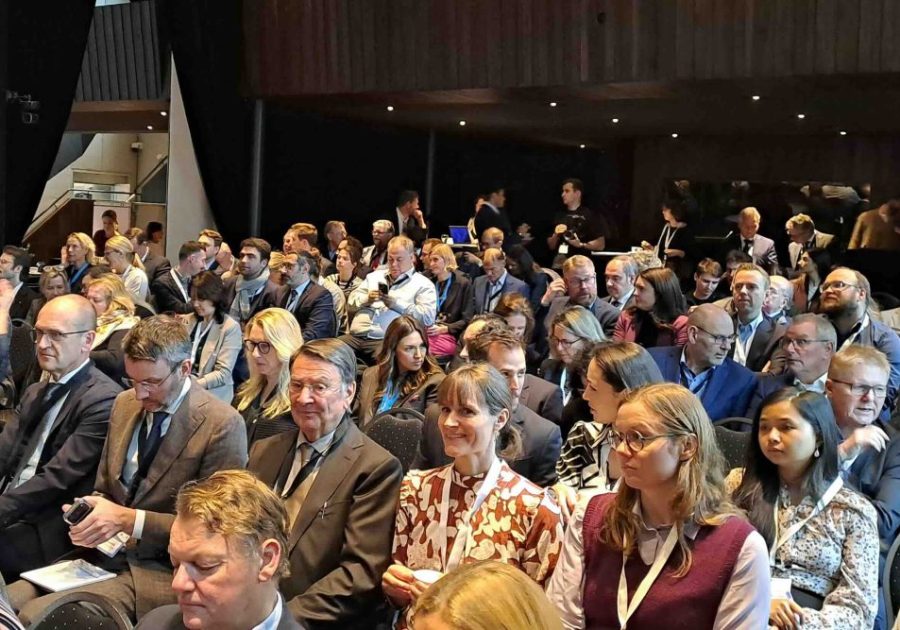
Credit: European Dairy Association
The European dairy sector will survive many challenges it currently faces, including low milk prices, trade wars and the difficulty of attracting younger generations to farming, by using innovative techniques. That was a key message of the 12-14 November European Dairy Association (EDA) annual convention, in Utrecht, the Netherlands.
At the meeting, Albert de Groot, EDA president, declared, “Our industry’s success is based on a shared vision, a well-functioning internal market, an ambitious trade policy, and strong collaboration within the dairy chain. Moving forward, our focus will be on nourishing a sustainable future and nurturing innovation.”
CEO of the Nijkerk, Netherlands-based dairy company Vreugdenhil Dairy Foods and board member of the Dutch Dairy Organisation (NZO – Nederlandse Zuivel Organisatie), de Groot, added, “We are the global dairy superpower – also with ‘super powder’ [a nod to Vreugdenhil’s Dutch milk powder] – we are leaders in innovation and sustainability.”
Mireille Einwachter, the NZO chair, agreed, telling the convention, “Our sector is built on collaboration, innovation and generations of craftmanship. Dairy supports tens of thousands of jobs and is central to [Europe’s] economy and communities.”
Indeed, de Groot argued that the sector is “the backbone of the European countryside with €18 billion in revenue, 12,000 milk processing and dairy product locations, more than 300,000 specialised employees and 53,000 dairy farmers who form the core of our milk production.”
In his opening speech to the convention, he said the sector shows, “remarkable resilience and global leadership even in volatile times, driven by the people who innovate and sustain a strong value chain. To continue thriving, we must seize opportunities, reinforce our supply chain and invest in progress.”
“Dairy is the cornerstone of life,” said the convention’s keynote speaker, the Dutch minister of agriculture, fisheries, food security and nature, Femke Wiersma, who said that growing up in a farm meant, “I learnt to respect how food is produced.”
EDA communications officer Alexander Roth told DII after the meeting that new tools, improved practices, and innovative products and advanced environmental technologies including Renure (REcovered Nitrogen from manURE) (1) and efficient dairy sector biogas production “reduce the ecological footprint while strengthening farmers’ resilience, creating quality and quantity.”
Roth explained, “Herd management, heat-stress mitigation and improved feeding strategies will help to reduce emissions while maintaining animal welfare and profitability. Equally important are multi-stakeholder partnerships among technology companies, processors and farmers to create scalable solutions for quality assurance, GHG reductions and productive operations.”
He stressed that sustained innovation requires close collaboration by European dairy manufacturers and suppliers with knowledge institutes such as the Netherlands’ Wageningen University & Research and Ireland’s University College Cork (UCC), “advancing research in nutrition, proteins, processing and the dairy matrix.”
Indeed, UCC professor of dairy research & innovation Thom Huppertz told the convention it was essential to invest in knowledge and scientists to secure the future of innovation, adding, “Complexity is not scary; confusion is.”
Such innovation has the support of the European Commission, with Ursula von der Leyen, the EU executive’s president contributing a note to the EDA convention programme publication arguing that that sustainable innovations, supported by the European Green Deal (2), the strategy launched in 2019 to cut emissions by at least 50 per cent by 2030, strengthened European competitiveness. “I am proud that European dairy professionals are leaders in precision dairy farming, alternative feed sources, methane reduction techniques, water recycling systems, renewable energy on farms and eco-friendly packaging,” she said.
Alisa Tiganj, member of EU commissioner for agriculture and food Christophe Hansen’s cabinet, added that 2025 has been a year focusing on “rebuilding trust and relationships with farmers” and that dairy, as “a sector of innovation and strategic for economic security and resilience… providing continuity in a constant time of change,” was part of the solution to Europe’s economic and social challenges.
Highlighting a shift in Commission thinking in the year since Luxembourger Hansen took office on 1 December 2024, she told delegates that in the past the Commission would aim higher on green issues and it was still on track here, but “we need to find a right balance with competitiveness” and simplification of regulation and cutting red tape was important too.
She said that the new approach seeks a more balanced alignment between sustainability and the competitiveness of Europe’s agricultural sector: “European quality and origin must stay visible worldwide.”
While no one would deny the need for sustainable, quality products, Dr Rob de Wijk, professor at Leiden University, the Netherlands, and founder of The Hague Centre for Strategic Studies, argued that while arguing that quality was better than quantity was legitimate, in reality both were needed: “Sustainability is an ongoing process, but to be successful we need a sufficient number of farms, milk and dairy producers. Quantity matters,” he said. “If not, we will lose the game.”
For de Wijk, “Concepts like local production and consumption are romantic ideas, but they do not help” build a strong and sustainable sector. Moreover, tough EU environmental rules on nitrogen, curbs on fertilisers and other climate change measures (3) had contributed to warnings, for example in Dutch cooperative bank Rabobank’s 2024 report (4), that milk production in northwest Europe might decrease 20 per cent by 2035. To compensate, he concluded, instead of giving up on nature or relaxing regulations, the answer was technical innovation.
Companies at the conference spreading the message that innovation is key for success, particularly if everyone works together, included the Dutch-Swiss nutrition, health and and beauty innovator dsm-firmenich, Vreugdenhil Dairy Foods, the Zutphen, Netherlands-based dairy laboratory Qlip, and the Swiss packaging manufacturer, Tetra Pak.
“Success is all about partnerships,” said Dennis Rijnders, vice president global sales and business development for feed additive Bovaer at dsm-firmenich. “If many people with bright minds get together, we can do it.”
Rijnders claimed to the conference that by feeding cows a quarter of a teaspoon of Bovaer per head per day, methane emissions could decrease up to 30 per cent for dairy cattle and up to 45 per cent for beef cattle.
After the event, he told DII that Bovaer, developed in 2008 and approved by the European Food Safety Authority (EFSA) in 2022, “works with innovation throughout the value chain to help improve profitability and reduce waste.”
Dsm-firmenich’s Rijnders also highlighted his company’s Delvotest antibiotic residue testing (5) system that prevents milk from being wasted, improving farmer and processor profitability, while another innovation, Maxiren Evo (6), “is our new cheese enzyme that provides manufacturers with better yields and increased processing flexibility, once again improving profitability.”
He added that “through our taste capabilities, we help new high protein dairy products to have great taste and texture. And by using AI to categorise our enormous cultures and enzymes bank and better tailor product development to customer needs, we shorten the innovation process, reducing costs and time to market.”
Ilonka Nennie, sustainability manager at Vreugdenhil Dairy Foods, the Dutch family company founded in 1954, now an international milk powder specialist, also told the convention innovation was “a no-brainer.”
Nennie explained to DII at the conference that “investments in manure digestion, soil health and regenerative practices strengthen farms against climate risks and improve self-sufficiency. This fosters a culture of courage and innovation in the sector; it can adapt to changing circumstances and inspire younger generations.”
Vreugdenhil is committed to building “a future-proof dairy chain through the ‘Tomorrow’s Dairy’ programme (7), started in 2022 in partnership with Nestlé,” she said.
“This aims to cut greenhouse gas emissions by 50 per cent per kilogram of milk by 2030 compared to 2018 levels, using regenerative farming, tailored reduction strategies and scientific insights from the Wageningen University & Research,” she said.
The convention heard that innovation is important at all stages of the milk production chain, from testing to finished product. Jan Bobbink, director of MLZ Holding, the mother company of Qlip, which carries out independent analyses in the Dutch dairy sector, highlighted the role of innovation for quality assurance of dairy through continually evolving methodologies to measure raw milk quality.
And Lorenzo van Haelst, managing director of global packaging giant Tetra Pak France, Belgium and the Netherlands, said innovative packaging solutions can help secure access to safe and nutritious dairy. Its aseptic packaging protects liquid food, such as milk, and retains its colour, texture, natural taste and nutritional value without the need for preservatives or refrigeration.
Another example on show in the conference centre foyer was North Carolina, US-headquartered Sealed Air’s Cryovac vacuum shrink packaging, sold as ‘made to protect, ready to recycle’ (8), around a very lifelike, but nevertheless fake, cheese.
“There are many challenges ahead, but through innovation and collaboration across the dairy industry, we can turn them into opportunities and build long-term resilience,” van Haelst concluded. “Let’s be bold, the technology is available, and we are investing for even better solutions.” It was a message also conveyed through the documentary showing life on dairy farms in Europe, “Between Heritage and Innovation. Portrait of Dairy Farmers in a Changing Europe” (9), presented at the conference.
NOTES
1 – environment.ec.europa.eu/news/commission-welcomes-renure-agreement-nitrates-committee-2025-09-19_en
2 – commission.europa.eu/strategy-and-policy/priorities-2019-2024/european-green-deal_en
3 – www.consilium.europa.eu/en/policies/fit-for-55/#what
5 – delvotest.com/
7 – www.vreugdenhildairyfoods.com/tomorrows-dairy
8 – www.sealedair.com/products/brand/cryovac
9 – www.youtube.com/watch?v=lPgf7LY_W78&feature=youtu.be
Topics
Europe European Green Deal market outlook milk powder packaging
PeopleAlbert de Groot Alexander Roth Alisa Tiganj Christophe Hansen Dr Rob de Wijk Ilonka Nennie Lorenzo van Haelst Mireille Einwachter Thom Huppertz Ursula von der Leyen
OrganisationsCryovac dsm-firmenich European Dairy Association (EDA) European Union (EU) Leiden University Qlip rabobank Tetra Pak University College Cork Vreugdenhil Wageningen University ZNO
Regions