Sustainable filtration in focus at SDT
Credit: SDT
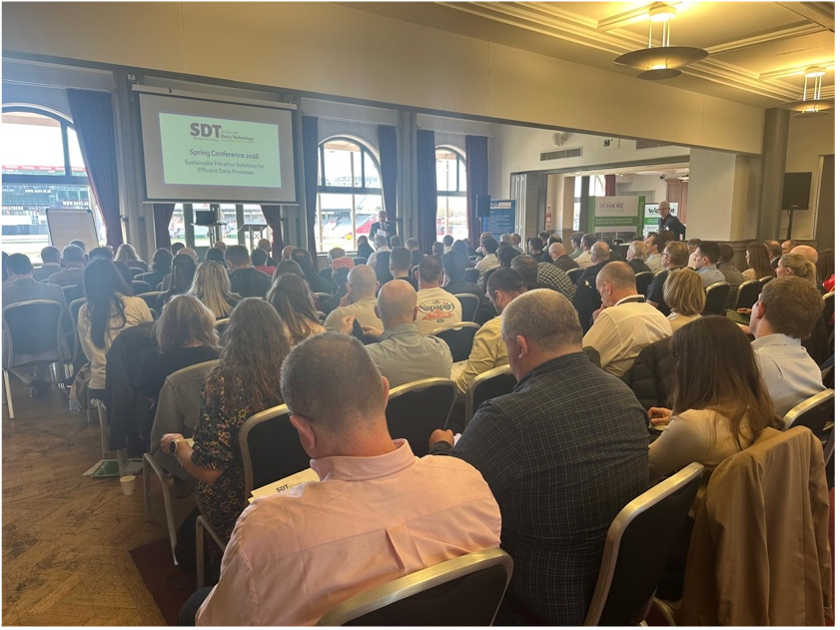
Sustainable Filtration Solutions for Efficient Dairy Processes, the Society of Dairy Technology’s spring conference theme, was held at the Old Trafford Cricket Ground in Manchester, UK at the end of March. Prior to the conference, 16 delegates attended a visit to Kersia, where they were given a tour of the factory and an overview of the company’s latest product developments.
Of particular interest was Kersia’s new smart technology platform, which uses artificial intelligence to optimise Cleaning in Place (CIP). By monitoring chemical dosing, rinse cycles, water consumption and cleaning performance, the system can build a detailed picture of plant operation and identify opportunities to reduce chemical and water use while ensuring cleaning regimes remain fully effective. The evening before the main conference, around 50 delegates gathered for a dinner in the members’ suite at Old Trafford Cricket Ground, providing an opportunity for networking and informal discussion ahead of the technical programme.
Opening the conference, Society president Michael Pinches welcomed delegates and took the opportunity to thank Marian, executive director of the Society, for her dedication over the last eight years, during which she has organised an impressive 20 conferences. A formal vote of thanks recognised her hard work and commitment to the Society, as her last conference before her retirement.
The technical programme began with Paul Rowe of Pure Process Consultancy, who provided a comprehensive overview of membrane technology in dairy applications. His presentation set the scene for the day, covering the four main membrane types used across the sector – microfiltration, ultrafiltration, nanofiltration and reverse osmosis – and explaining the role each plays in modern dairy processing.
The benefits to the industry are considerable, from higher protein yields and improved product recovery to reduced energy demand and lower carbon impact. However, Rowe was also keen to highlight the practical challenges encountered in day-to-day operation, particularly membrane fouling, which can compromise both product quality and plant efficiency. The importance of robust CIP procedures, temperature control and careful operational management was emphasised throughout, with attention to detail described as critical to maintaining membrane performance.
The next session moved from broad principles to emerging applications, with Thomas Roersma of Wafilin Systems and Leila Salter of Sycamore Process Engineering presenting on advanced membrane solutions, with a focus on hollow fibre microfiltration and whey protein isolation.
Hollow fibre membranes are already widely used in beverage clarification, particularly in beer and juice processing, and the speakers demonstrated how this technology is now finding increasing relevance within dairy. Compared with ceramic alternatives, hollow fibre systems offer lower energy consumption and the ability to tolerate higher cleaning temperatures and pH conditions. Applications discussed included whey concentration, colour removal from whey streams generated by coloured cheese manufacture, and clarification and defatting during whey protein isolate production. Yield improvement was a key theme, with the technology offering clear advantages in product recovery and process efficiency.
A strong sustainability and profitability message followed in the presentation by Leif Iversen of CFR, who explored how advanced membrane systems can support smarter use of raw materials and utilities. The presentation focused particularly on crossflow membrane technology and the control of transmembrane pressure (TMP).
Better control of TMP was shown to be fundamental in reducing fouling, lowering energy consumption and extending membrane life. Lower pressure operation can also reduce membrane area requirements and improve process stability, ultimately delivering both environmental and commercial benefits. Iversen also discussed the growing use of AI-based smart operational tools, designed to analyse plant performance and optimise membrane replacement schedules. The clear message from the session was that good TMP control underpins both sustainability and profitability.
Manufacturing and end-of-life considerations came under the spotlight in the presentation from Michael McLoughlin of Synder, who examined the challenges and developments surrounding spiral wound membranes. The detailed production process, from material preparation and membrane casting through to phase inversion, rolling, curing and cutting, highlighted the complexity involved in manufacturing these widely used systems.
Membrane preservation was also discussed, with vacuum packing and preservation liquids playing an important role in preventing oxidation and maintaining integrity during storage. The session also addressed regulatory and environmental issues, including concerns around leachable microplastics and recycling. Recycling remains particularly challenging due to the multiple materials used in membrane construction, often requiring mechanical and chemical separation methods.
Looking at forever chemicals
A notable point of discussion was the industry’s response to concerns around PVDF and PFAS-related “forever chemicals,” particularly with tightening legislation in international markets. Work is already underway to develop alternative chemistries, although changes to membrane material inevitably affect performance and cleaning characteristics.
Cleaning optimisation formed the focus of Gareth McCabe’s presentation from Christeyns, which addressed the increasingly important issue of achieving effective membrane cleaning while reducing environmental impact.
Given the wide variety of dairy soils — from high-protein and high-fat residues to highly viscous product streams — McCabe emphasised that cleaning strategies must be tailored to the specific process and membrane material. Factors such as pH, temperature tolerance, local discharge restrictions and soil composition all influence chemical selection and cleaning effectiveness.
The role of surfactants and enzymes was discussed in detail, particularly in targeting fats and proteins. However, challenges remain, including foam control, rinse efficiency and the potential risk of membrane damage through poor manual dosing practices. Environmental considerations were also high on the agenda, including heavy metals and nitrogen-containing chemicals, with increasing pressure to reduce pollutant loading into effluent systems.
Automated dosing and improved data capture from plant operations were presented as valuable tools in optimising chemistry and restoring membrane flux more effectively.
A valuable end-user perspective was provided by Dr Phil Evans of Arla Foods Ingredients, who spoke candidly about the practical challenges encountered with membrane applications over many years in dairy processing.
Drawing on experience in the production of lactose, WPC80 and WPI, Dr Evans outlined a range of operational issues, including delamination, blistering along glue lines, telescoping, leakage, fouling and physical membrane damage. Despite these challenges, the opportunities remain significant. Membrane technology continues to support better raw material utilisation, lower energy consumption and more sustainable processing, while also opening opportunities for innovation and value-added streams such as animal feed and water recovery.
Biofilms and RO
The final technical session, presented by Derek Pitman of Indigo Food Solutions, focused on water recovery using reverse osmosis, an area of increasing importance as water costs rise and sustainability targets tighten. A key message from this presentation was that recovered water systems must be treated with the same level of hygiene control as product systems. Storage tanks, lines and silos all require regular CIP and effective disinfection to prevent microbiological issues.
Pitman highlighted the risks associated with biofilm formation, membrane ageing and inadequate disinfection, particularly in early water recovery systems where recovered water was not sufficiently polished or retained. The use of UV treatment, controlled recirculation and careful feed quality management was presented as essential to maintaining water quality and preventing contamination.
The discussion around biofilms proved particularly relevant, with emphasis placed on the glue-like protective matrix that allows bacteria to establish and persist in poorly controlled systems.
Summing up the day, Michael Pinches reflected on the recurring themes of membrane materials, transmembrane pressure control, biofilm management, cleaning optimisation and water recovery. He also reminded delegates of the pilot plant facilities available at Reaseheath for future trial work and process
Topics
cleaning-in-place (CIP) filtration membrane technology microfiltration nanofiltration technology water consumption
PeopleDr Millie Preece Dr Phil Evans Gareth McCabe Leif Iversen Leila Salter Marian Pusey Michael McLoughlin Michael Pinches Paul Rowe Thomas Roersma
OrganisationsArla Food Ingredients Arla Foods Ingredients CFR Christeyns Food Hygiene Persia Pure Process SDT Snyder Sycamore Process Engineering Wafilin Systems
Regions