AI on the future

Credit: Mettler Toledo
As AI advances and the demands for accountability move up and down the supply chain, manufacturers such as Mettler Toledo are spending time and money on new products that provide the client with what they need for serving the FMCG industry. Miriam Krechlok of Mettler Toledo International sat down with Dairy Industries International and detailed the challenges and the opportunities for the sector.
Q. How is the new inspection product being received by your customers?
We showed these new systems at Interpack in May. Designed as the next generation of metal detection, the M50 R-Series delivers improved detection sensitivity and is engineered to increase productivity while simplifying compliance in modern production environments.
The new trend in product inspection is where it’s not only about performing the checks, but also more about how can you support the user in terms of efficiency, reducing waste and managing operational costs. Obviously that’s where AI come into the game. Then, it’s specific questions towards the technology itself or how the operator handles the machine.
Q. What are your customers looking at, as they look up and down the supply chain?
The discussions we have are about more than just energy consumption, for example. They ask us what can we specifically do. When it comes to product inspection, it’s often about fewer wrong rejects. Then this means less food waste, which means fewer false alarms and better use of resources. When it comes to sustainability, it’s where we can support customers the most and close the loop. AI is beginning to transform how product inspections work, as well as quality management.
What does it mean in concrete terms is that for X-rays especially, is better image analysis. The global debut of the new M50 R-Series metal detector has shown customers the machine now has a better understanding of the natural product variations, I would say. This results in fewer false alarms and more stable processes.
For example, let’s look at cheese. Cheese naturally varies in density and its structure itself. When you sell the cheese, there are often slices of cheese in a pack. So you have overlaid products, which even makes it difficult to see if it is a natural product variation or if there really is contamination. AI can really help inspection systems better distinguish between the normal product variation and actual foreign body risk.
Q. How are energy costs affecting the sector?
Energy remains a major cost factor. And on the other hand, there are staff shortages in many plants. Then we see the pressure from retailers and them becoming stricter with regulations. At the same time, manufacturers have to keep the high quality standards and try to do that at lower costs. They are looking for a solution that they can do more with, rather than just simply seeing what our machines can do, whether it’s contamination detection or fill level checks. It’s about simplifying compliance topics, and making it easier for operators – having data available that is easy to read and understand, and is easily translated into audits. Actionable production data is key. It’s all about data driving on the one hand, and the cost problems on the other hand, and how we can support efficiency.
Q. For your typical machine, how much more energy efficient are they than five years ago?
Some of the X-ray systems have reduced their energy savings by 30 per cent over the more traditional versions. It’s more the X-ray that everyone focuses on, probably because they are more complex machines.With all of our systems along the production line, we more or less play a part in the entire dairy production process, , from lab research and development and analysis, to the end of the line with inspection, detection and check weighing.
One customers was producing milk powders. They were thinking about having automation solutions in line. We had to consider the space in the plant. So they were looking at solutions which combined check weighing and metal detection, or check weighing and X-ray solutions.
Meanwhile, the staffing issue occurs more often, so an automated system becomes more important. It is obviously more expensive at this stage of buying the machines, but just at the beginning. Then its ROI is short as the energy and staffing issues are considered.
That’s something where we will always look for improvements, in how to do that better, and how to use design to operate better in the hygienic environment. The new metal detector systems, the M50 R-series, for example, have a touchscreen that can be worked using gloves. This was a suggestion from the operators of the older systems and in the dairy sector.
We really have to think about where the pain points are for the operator using the line. So it needs to be simple, and it needs to solve the problems. And when the problem is that they can’t touch it because they have to keep taking their gloves off, and have to think, oh, where can I put my gloves in a hygienic design environment, that is something we can help with. I mean, if that’s the problem, we now have solved it.
Q. How are you helping customers to use the data they collect?
We have seen an increasing demand for digital connectivity and centralised monitoring. So data quality is no longer collected simply for audits. It’s being used to also optimise the processes and identify variation trends.
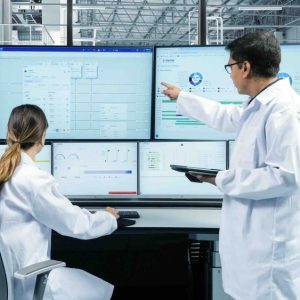
ProdX, our data management software, connects product inspection devices across the line into a single, centralised view. It gathers results in real time, automates data capture and traceability, and helps foodmanufacturers strengthen digitalisation, documentation and food‑safety compliance across the operation.
For example, when the filler is not working correctly, that’s something where we can get feedback to the filler itself based on the data coming in. It then supports faster decision making across multiple production sites Our software collects the data given from various production points – from the metal detector, the x-ray and so on, and they can easily see the problem occurring, and you can immediately act at this stage. You don’t even have to lose an entire batch.
At the core, it collects the mistakes that can happen at line. And when you use it across multiple sides, you know this mistake already from another site and you can leverage this information for other sites. That’s a huge benefit for it. So the data is used proactively.
It connects all the product inspection systems on the line and in real time it monitors and captures all that data, and securely stores that data. The system is connected to the MES or an ERP or whatever the manufacturer would have, that’s when you can really analyse and get more sophisticated reports. That then really can make differences and savings for dairy manufacturers.
It’s about increased efficiency as well. Plus, if there is a product recall, it’s easily retrievable data. We often assume companies have sophisticated systems, but there’s still companies still rely on the random sample checks for one reason or another.