Meeting the challenges for food safety and quality

Credit: M Pusey, SDT
The Society of Dairy Technology’s Autumn Symposium was held at NAEC Stoneleigh the day before our very own Dairy Industries Expo on 28 October, and its theme was “Challenges in Food Safety and Quality in Dairy Product Manufacture.”
Mike Pinches, the president of the SDT, opened by noting his first year as president “has been very busy and rewarding.” The Society’s summer symposium was well-attended, with the annual dinner seeing record numbers. He also noted the International Journal of Dairy Technology has moved from hard copy into continuous publication on the website, with Dairy Industries International regularly providing a space for the summaries written by Dr Liz Whitley. It will be moving wholly to open access over the next few years, and he thanked the editor Michael Collins for his work.
Andrew Collins, a consultant with Campden BRI, was up first to discuss the importance of good hygienic practices and delivering consistent safe food. He looked at the general principles of food hygiene, the importance of properly applied prerequisite programmes, which include good hygiene practices (GHPs), and which should provide the foundation for an effective HACCP system.
“Depending on the nature of the food, the process, and the potential for adverse health effects, to control hazards it may be be sufficient to apply GHPs, including, as appropriate, some that require more attention than others, as they have a greater impact on food safety. When the application of GHPs alone is not sufficient, a combination of GHPs and additional control measures should be applied,” he observed.
The issue should focus critically more on prevention versus mitigation, Collins added. “In the general principles of food hygiene, food hygiene systems should be reviewed to determine if modifications are needed.”
A holistic more complex model may be employed, with the food safety hygiene plan at the top, while safety, operations and the branding are next. There is a regulatory framework for safety, including: quality, authenticity, PRPs, supply chain traceability, allergen management, hygienic design, HACCP and fraud and vulnerability. “This should all be underpinned by management and workforce commitment,” he noted. “It is the essence of risk management. Being in control of what you do is about being able to answer the basic questions, such as, do we understand what can go wrong?”
Food safety hazards may be inherent from natural environment or a natural activity, or introduced as a result of production processing, or introduced via human intervention.
“It is really about trying to put a measurable criteria against the distinct elements. Control measures are about how often you interrogate prerequisites and the general principles of food hygiene. “The application of GHPs alone is sufficient to manage some or all of the hazards. All GHPs are important but some have a greater impact on food safety,” he observed. “Codex has several definitions for good hygienic practices, including labelling, management of allergens and looking at primary production. One of the more important factors now, is about water, and the use of water from a microbiological safety standpoint. Water is a precious resource, but how water is used, and what hazards are managed with it, is also key.
“When we evaluate the barriers, the first definition to validate and substantiate, and to provide evidence that something is true. We have to identify those that are crucial, because GHPs without control and maintenance and calibration will cause your CCPs will fail.”
Vince Adams followed. in a discussion on HACCP and all the things that contribute to it. First, a key is to look at what is the source of the HACCP challenge, he asked. One is detection, where someone looks at it. Then, it is verification, where someone audits it and if there’s a nonconformity, it is formally raised. Further, it’s about the impact of change, either on a product, a process, the premises or personnel. Lastly, it’s about product outcomes, with a withdrawal or recall.
“People are an important part of HACCP,” he observed. “The consumer has to be at the centre of everything we do to make sure the product’s safe, as someone’s going to consume the product. People have to be trained appropriately to assess the data generated, be clear on the schedule and the content of HACCP reviews. HACCP knowledge is important.” Through the whole process, there are several areas for top concern: raw material controls, heat treatment, cooling, fermentation/pH/acidity development, packaging controls, foreign body controls, storage controls and allergen controls.
“In the future, there will be more AI-powered monitoring,” Adams noted. “The future of dairy food safety will include cloud-based platforms to manage systems, along with device integration. From farm to fridge, there must be safety at every step.”
Tesco’s Kay Brennan discussed working together to achieve high quality and consistent audit standards. Why the British retailer does additional checks and balances with its own supplier audits, is simple, she observed. The brand integrity’s value, she noted, is worth £28 billion. Her area is speciality cheese, and its audits look at items ranging from design and construction of the premises, to employee facilities and workwear. High care and high risk foods, such as unpasteurised raw milk cheese have to be held to the highest specifications, she observed.
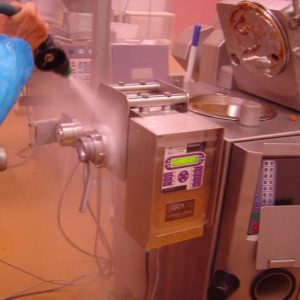
Last speaker of the day was Hein Timmerman, a global sector specialist at Diversey F&B and also the EHEDG president, who spoke about dairy equipment and process design for controlling listeria. Hygienic design is important, he noted, because “Failures in hygienic design not only lead to the accumulation of residue which in turn leads to contamination, but also lead to the accumulation of residues of cleaning and disinfecting chemicals, increase the risk of corrosion and can contaminate subsequent batches of the product. Failure of hygienic design can lead to contamination, such as foreign materials, allergens, lubricants and disinfectants.” He then discussed the US regulatory framework and its components.
Topics
food safety HACCP hazards hygiene symposium
PeopleAndrew Collins Hein Timmerman Kay Brennan Mike Pinches Vince Adams
OrganisationsCampden BRI EHEDG NAEC Stoneleigh Society of Dairy Technology Tesco
Regions