Growth in Germany
Credit: Jens Kastner
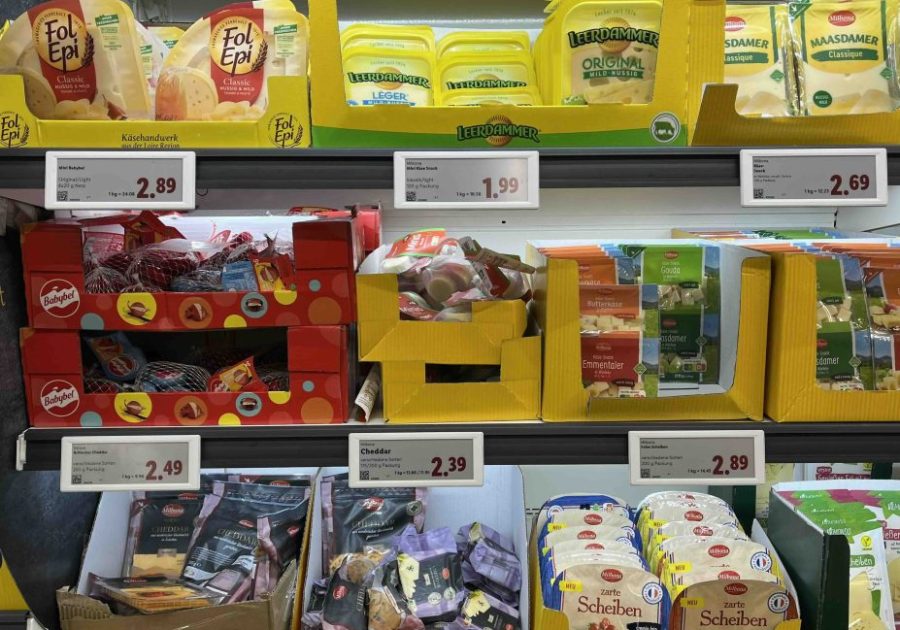
The German dairy market grew 5.2.% year on year in 2025, to €29.3 billion, representing a significant acceleration from the 3.6% growth recorded in the previous year, according to data provided by UK-based market researchers Euromonitor International. With 6.5% growth, the cheese segment led the pack in 2025, followed by butter and spreads at 4.8%. However, the market researchers expect overall year-on-year value growth to slow to 3.3% in 2026, amidst ebbing inflationary pressures.
“Dairy products and alternatives in Germany are expected to see slower value growth following the price hikes and inflationary pressures of recent years,” says Raphael Moreau, senior consultant at Euromonitor International. “Lower inflation has provided some relief for consumers, with some dairy categories such as butter even recording declining prices.”
UK-based market researcher Mintel sees Germany’s dairy consumers as placing great value on quality, regionality and sustainable production. Products with regional origins and sustainable attributes are perceived as high-quality and can therefore command higher prices.
“Already, 90% of new product launches in this segment originate from German production, which is a clear advantage in the current geopolitical environment, characterised by uncertainty and a growing preference for local brands,” according to Hope Banks Petrikowski, Mintel food and drink analyst. “Transparent communication about regional roots and support for domestic agriculture strengthens consumers’ emotional connection and increases their willingness to pay.”
She adds that the cream segment is growing strongly in Germany, driven by more home cooking. “Since younger consumers show a strong interest in a wider variety of flavours in milk drinks and cream, there is potential for innovative flavours specifically designed for cooking,” explains Petrikowski.
To get a grasp of the upstream situation in northern Germany, DII spoke to Lars Kaper, chairman of the Friesland District Farmers’ Association (Kreislandvolkverband Friesland). He runs a family-owned dairy farm in the town of Varel in Lower Saxony, with approximately 500 dairy cows, above that region’s average of 120-150 cows, which is itself larger for Germany. Approximately 80% of the farm’s revenue comes from milk, 10-15% from meat, with arable farming accounting for another small share. Wheat, barley and rapeseed are cultivated and used as animal feed or sold to the plant-oil industry. Field beans (legumes) are milled and fermented to serve as protein- and energy-rich feed, replacing concentrated feed bought from external sources, making it an integrated feed concept.
Kaper’s farm has open-air barns with open walls; the temperature follows the outside temperature, and heat management is achieved through techniques such as ventilation and water cooling for very hot days. Cows have year-round 24/7 access to water, feed and the automatic milking system, creating continuous cycles and avoiding peak times.
“Tie-stall housing [tethering cows by their necks to stalls] is rare in northwest Germany and is being phased out, with loose housing, where cows move freely within a large area, often in open-air barns, being dominant,” Kaper said. “Automatic milking systems (AMS) are standard in new buildings, with many older barns being retrofitted.”
One reason for 2025 production growth is summer 2024’s rapid spread of bluetongue disease in northwest and western Germany, depressing milk production as adult dairy cows especially were sick and fevered through virus-related changes to the head, udder and hooves. Pregnant cows experienced miscarriages or delivered an increased number of weak or blind calves. The mosquito-borne virus is not transmissible from animal to animal and is harmless to consumers, but the reduced milk output inevitably pushed up prices.
“Vaccination accompanied the outbreak, surviving cows formed antibodies, and the winter stopped mosquitoes, so many cows became pregnant again, leading to increased calves in autumn 2025,” said Kaper said, adding that milk production increases with calving, caused milk deliveries in Lower Saxony to currently be up by 7-8% year-on-year in February 2026.
In terms of trade policy, Kaper welcomed that China has significantly reduced its planned tariffs on European Union dairy exports to between 7.4% and 11.7% for five years, starting 13 February 2026, down from the originally proposed 21.9% to 42.7%. These duties, following an 18-month anti-subsidy probe widely seen as a response to EU levies on Chinese electric vehicle imports, target products like cheese and milk-powder, with the lower rates aimed at mitigating trade tension(1).
“China’s tariff reductions on EU dairy products boost sales, nurturing our hopes for a better year with reduced international tensions,” Kaper says.
However, the industry has more concern about the impact of tightening German regulations. For example, from 1 January, plant protection documentation requirements in Germany became more stringent, with an increased focus on detailed, standardised, and eventually fully electronic records, complying with EU Implementing Regulation 2023/564. Stressing how this impacts his animal feed production, Kaper criticises the detailed requirements, including international crop codes and photographic evidence, as excessive and impractical. “German authorities are using digitalisation [as an excuse] to get excessive control on German farmers, leading to shrinking motivation especially for younger farmers,” warns Kaper(2).
The south
In southern Germany, the dairy sector is characterised by different geography and commercial composition than northern Germany. Bavaria, which accounts for approximately 40% of German milk producers, has many medium-sized dairies and more diverse ownership structures than in the north.
“An average of 47 cows per farm in Bavaria leads to higher production costs than larger farms in the North,” says Dr Hans-Jürgen Seufferlein, director of the Bavarian Milk Producers Association (Verband der Milcherzeuger Bayern). “Topography and historically developed structures result in higher production costs, necessitating higher milk producer prices to compensate for these disadvantages even though consumer prices are largely identical nationwide, with, for example, mozzarella and butter of store brands and manufacturer brands, costing the same in Hamburg, Berlin or Berchtesgaden in southeastern Germany.”
However, he adds, Bavarian dairy farmers are cushioned by more diversified income sources by around 50%, combining animal husbandry with vacation rentals, especially in Alpine regions between Berchtesgaden to the Allgäu. Farmers get up early to milk cows at 5am, leaving them time to provide services to vacationers at 7am, which increases flexibility and stability, according to Dr Seufferlein.
That said, the smaller Bavarian herd sizes limit the distribution of fixed costs and slows introduction of technology. Unlike in northern Germany, investments in AMS free-stall barns, feeding and cleaning technology are not cost-effective for smaller herds. Hesitancy also stems from political and regulatory uncertainty stemming from state and federal government discussions on blocking the use of tethering or combined housing, where cattle spend some time outside in fields but usually eat inside barns, combining tethering with temporary periods of free movement in pastures, exercise yards or pens.
Such restrictions could jeopardise planning and profitability, warns Dr Seufferlein, especially in southern Germany. This issue is also a live concern in neighbouring Austria.
A major concrete regulatory headache is emerging in the form of a general decree issued in February 2026 by north-west Germany’s Lower Saxony by its agriculture ministry aiming to phase out both year-round and seasonal tethering, with transition periods depending on the type of housing (3).
Although the decree is focused on one German state, Dr Seufferlein says its terms might end up being imposed in southern Germany, and maybe without further regulatory intervention.
“Since all suppliers deliver to the food retailers like Aldi, Lidl and Edeka, a ban in Lower Saxony could influence requirements nationwide,” says Dr Seufferlein.
Drinking milk sold in Germany is already classified under an industry voluntary labelling system as requiring producers to follow ‘animal welfare level 3,’ which excludes tethered and combined housing systems. In Bavaria, approximately 50% of raw milk is processed into cheese, where animal welfare standards are sometimes not yet a factor. However, NGOs and retailers could still exert pressure and significantly impact the southern German dairy industry,” he adds.
Despite these regulatory challenges, Germany’s dairy sector remains innovative and is an enthusiastic adopted of R&D. Jörg Hinrichs, a professor at the Department of Soft Matter and Dairy Technology at the University of Hohenheim’s Institute of Food Science and Biotechnology, told DII how he is developing improved thermal treatment for UHT (ultra-high temperature) milk and plant-based UHT drinks. The hypothesis is that separating raw materials would optimise thermal treatment, reducing thermal stress in UHT milk and plant-based UHT drinks, which can impact quality. Currently, raw materials for UHT milk and plant-based UHT drinks are regulated uniformly, with the inactivation of thermophilic spore-forming bacteria being a mandatory requirement for both feedstocks. But in truth, Hinrichs says, the ambient level of thermophilic spore-forming bacteria is much lower in milk, (less than 100 spores/ml) than in plant-based raw drinks, (“the value is < 10⁵ spores/ml – we have seen maximum values of 10⁷.”). He adds, “In practice, the holding times and temperatures for thermal treatment are higher for UHT drinks than for milk. Nevertheless, non-sterile issues still occur. We are currently researching this, among other things.
“The anticipated research results on the CPT [customised phase treatment] process offers a competitive advantage for both milk and milk-analogue processing companies as well as smaller firms and start-ups,” Hinrichs says. “Smaller and medium-sized firms may preferentially utilise the insights and concepts of CPT processing in conjunction with microwave technology, as smaller volume flows need to be processed in niche dairy and plant-based products, such as sports nutrition and protein-rich products.”
Notes:
- www.globaltimes.cn/page/202602/1355259.shtml
- www.pflanzenschutzdienst-niedersachsen.de/pflanzenschutz/news
- www.ml.niedersachsen.de/presse