
Hay explains holes in cheese
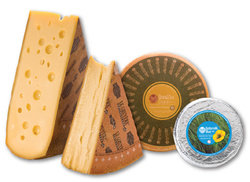
Holes in the cheese are an eye-catcher. Now it is known that they are caused by hay particles and can now be controlled during ripening. Many traditional Swiss cheeses such as Emmentaler or Appenzeller attach great importance to the appearance of holes. Therefore a lot of effort has been put into studying how exactly these holes are formed in the cheese, and how the cheese makers control the process of hole formation, so that the appearance of the cheeses corresponds to the ideal.
A new study by Agroscope (Swiss federal center for agricultural research) and the Empa (Swiss federal laboratories for materials science and technology) shows that hole formation in cheese is anything but a coincidence and solves the mystery of how the holes get into the cheese.
While Swiss cheeses like Emmentaler used to have too many holes in the winter, cheese in the last 10-15 years has had very few holes. This phenomenon has been linked with the improved milking technic and thus cleaner milk.
Researchers at Agroscope long suspected that hay may have the microparticles that cause the formation of holes in the cheese.
To study the development of holes (number, size and distribution) in the cheese during the ripening of 130 days, Agroscope and Empa developed a new method for detecting the formation of holes by computed tomography. The results of the trials were astounding for the researchers. Depending on the dosage of hay particles, the number of holes could be controlled in the cheese almost at will.
Thanks to this discovery it is now also possible to scientifically explain lack of holes. The traditional milking in the barn with open boilers has been replaced completely in recent decades by modern, closed milking systems. These technical improvements in milking technology have reduced the risk of unwanted microbiological contamination, but they have at the same time also reduced the entry of microscopic hay particles in the milk, which has caused fewer holes.

© Bell Publishing Group Limited, 2026. All rights reserved. Website by e-Motive Media Limited.