A panel to speak of at Dairy UK’s Annual Dinner
Credit: SChrist
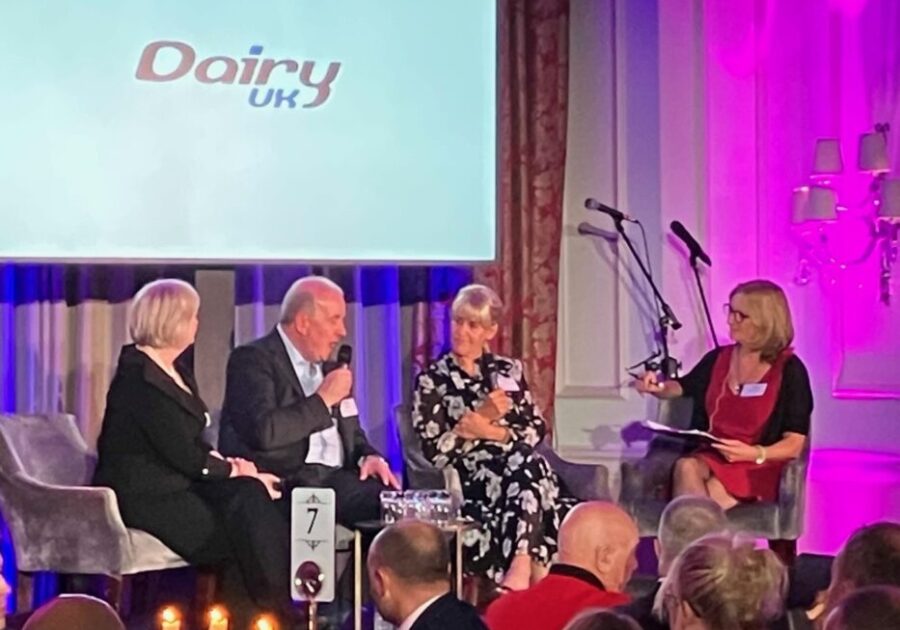
Amid the lights and camaraderie of the annual dinner hosted by Dairy UK at the Landmark Hotel in London, the group took time to provide a panel discussion on current events.
Caz Graham, British broadcaster, known for her work on the BBC’s Farming Today programme, facilitated the discussion, whose members included Dr Judith Bryans, Dairy UK’s executive director, Paul Vernon, chair of Dairy UK, and Baroness Minette Batters, former president of the NFU and current member of the House of Lords. The first question was simple and complex at the same time: how is dairy doing?
Dr Bryans answered, saying, “When I talk to members, the long-term sentiment is optimistic, and they feel the future is very bright for them. Our industry feeds the world in an increasingly sustainable fashion, and consumers in the UK love their dairy products. It continues to face issues – ranging from international policy, to weather, to the trade challenges.”
Vernon noted, “As for trade, dairy is doing really well. The challenges the UK dairy industry faces are from government trade policy, but the UK-EU deal puts the status back to pre-Brexit levels. However, it’s an agreement, not a policy. Defra plans to implement it in 2027, so it is not imminent. The recent UK-India trade agreement is very uneven. India wants to be the world’s largest milk producer by 2025 and there is no reciprocal access to the Indian market for British products.”
He further said that whatever happens next, “British agriculture needs to be involved. It’s different to being told what’s happening and us being involved in the negotiations.”
Baroness Batters observed, “The UK has one of the more prized food markets in the world. International companies are here because the quality and demand are here. And everyone knows this – except us,” she said to much laughter. Another issue is the endless turnover of ministers, no matter who is running the country, she added. “I have seen seven secretaries of state, and food supply is often taken for granted.”
Dr Bryans agreed, saying, “We take the time to get them to understand the relationship and setup of the industry, and then they’re off again. At the end of the day, we still want to work with the industry, and we can move faster than any legislation can. It would be great if these departments would show that they value agriculture and our sector, because we are feeding people.”
Vernon concurred, noting, “A period of stability would be welcome for a minister or two to get to know the dairy sector.”
Graham posed another question on how much farm support for environmental works exists and how that is going. Baroness Batters replied, “The first rule is about funding. If there are no sustainable food metrics, the products get exported abroad where they get a return. We can’t have diamonds in a paper crown, the support and funding for environmental practices have to be there for the farmers. We cannot afford for this country to keep paying lip service to building a process for these practices, if we get on a road we have to stay on it.”
The Dairy Roadmap 2030 was detailed, and Graham noted there has been a lot of collaboration between industry and the various actors in the supply chain. It was noted that the Roadmap has been in place for 18 years in the dairy industry. Dr Bryans observed, “It will allow us to accelerate the plans already in place, and other sectors are wishing they had done it 18 years ago. By working together, we get there quicker, and we need to do this – we don’t want to be held back by government policies.”
Baroness Batters agreed, saying, “Dairy has been ahead of the game, earlier and faster. We’re already decreasing impact and increasing yield.”
Graham asked about the continuing public perception of dairy. Dr Bryans said, “British people love dairy, it’s needed for nutrition and is in a huge number of fridge in the UK. What drives me crazy are reports such as the EAT-Lancet diet, which had very narrow parameters. A lot of academics who looked at it saw 1.5 billion people who couldn’t afford it and who would suffer from a lack of micronutrients on it. People have to stop saying we have to eat less dairy.”
Vernon concurred, saying, “Judith is being very polite. Another thing dairy brings to the table is huge innovation. There is an insatiable appetite for protein in the diet and dairy provides that. It is sustainable and highly nutritious.”
Baroness Batters said, “Dairy is highly nutrient dense and this is a massive driver.”
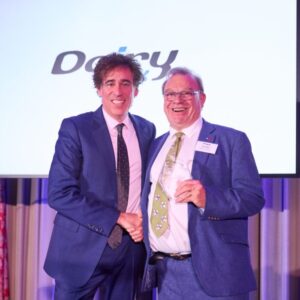
The award for Dairy UK Excellence, went this year to John Allen of Kite Consulting. As he said while accepting the award, “I have devoted my whole life to the dairy sector. They say it take a village, and this is a very special village. It enables us to collaborate along the supply chain and it has been a pleasure reaching out and getting to know you all along the supply chain over the years.”