Paying more for less
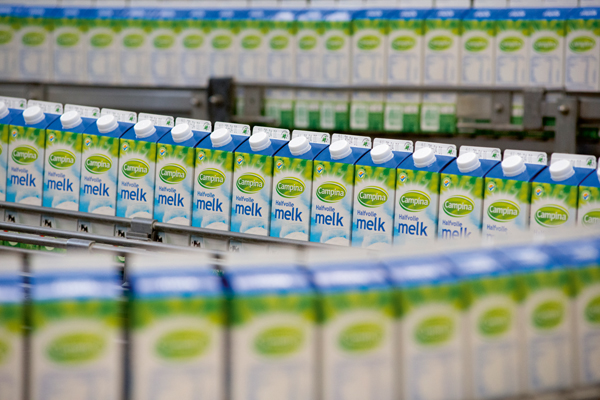
FreislandCampina has introduced an instrument for countering further increases in production in the milk market. The idea is for a bonus payment to encourage dairy farmers not to increase or even to reduce their production. The producers are to be paid an extra two euro cents per kilo of milk if during the period from 1 January to 11 February 2016 they supply not more, or even less, milk. This offer also applies to the German members of the dairy.
Sieta van Keimpema, vice president of the European Milk Board, says, “The dairies, too, are making it clear that unchecked growth in volume is problematic, and there must be instruments to counter it. FrieslandCampina (FC) has opted for a voluntary limit on supply, or a voluntary restraint on supply, because that is a very effective way of reducing volumes. It means positive action can be taken in the market and distortions prevented.”
Udo Folgart, vice president of the German Farmers’ Association (DBV), agrees. “Such decisions must be taken by dairies in liaison with their members on the basis of entrepreneurial and marketing opportunities. We therefore welcome this step by the company. This approach by Europe’s largest dairy cooperative also confirms that in the dairy sector, action is needed to shape the supply relationships.”
He says the current situation is unsatisfactory both for dairies and for dairy farmers: the dairies can, despite regular queries, not currently estimate reliably the amount so they know how much milk will actually be delivered to them in the future. And the farmers have no certainty as to the level of the producer price. “The responsibility must be shared between the dairies and their milk producers and be defined by the supplier relationships, which must be designed so that both agricultural entrepreneurs as well as dairies can predict long-term economies. It is about a modern refinement of the delivery obligation and the arrangements of volumes, prices, qualities and about the duration of these agreements,” Folgart says.
However, the Dutch company has not made its decision just to help sort out the market, van Keimpema says. “The reason FrieslandCampina decided to implement this arrangement is because they lack processing capacity. They didn’t implement this arrangement to clean up the dairy market or improve the farmers’ milk price. That is why the arrangement will only last six weeks and has no relation to the current market situation. I don’t think other dairies will follow FrieslandCampina.”
In fact, this move may not even sort out the issue it is meant to, van Keimpema says. “FrieslandCampina can face the same problems in a very short time again, because it counts on the delivery of 1.2 billion kg of milk to the Dutch Milk Foundation that it does not process itself (The provisions of this arrangement are in English here: http://www.stichtingdmf.nl). The danger of this arrangement for FrieslandCampina is that if the spot market prices stays low, because of the growing flood of milk and the lack of demand, no dairy will order milk by contract from the Milk Foundation, leaving FC with too much milk that it has no processing plants for. If FC builds more processing capacity to process the milk themselves, but that they always have to reserve for the Milk Foundation, and the other Dutch dairy processors decide to order again from the Milk Foundation, the capacity that FC had just built stays empty, costing enormous amounts of money. It is a very dangerous, but realistic scenario.”
Problem at EU level
In recent months, unchecked growth as a pan-EU strategy has caused huge problems and already driven many dairy farmers to ruin, she says. With prices in some cases at just €0.20 per kg of milk, survival is simply impossible for many farms.
“Up until now the Commission has not taken the right steps, because they have decided to abandon the milk sector with the current CAP. The Commission counts on the market instruments available like public intervention and private storage. These measures however, have had no positive effect at all since they were implemented from August 2014 onwards. But, if the Commission will be held by the European Parliament to the objectives of the Common Agricultural Policy in the Treaty of Lisbon Article 39, the CAP should, and I quote: ‘Ensure a fair standard of living for the agricultural community, in particular by increasing individual earnings of persons engaged in agriculture; and stabilize markets.’
“Extra market instruments have to be implemented as soon as possible to follow up on the objectives for the dairy policy in the Treaty of Lisbon.
“This instrument ought to be applied not just at individual dairies, but throughout the EU and thus managed centrally. Initiative on the part of individual dairies is not enough. It is up to politicians in particular to establish the proper legal framework for this, stipulating a market volume that enables prices to cover producers’ costs.”
Alluding to the passive attitude of EU Commissioner for Agriculture Phil Hogan, van Keimpema adds, “The EU politicians must finally act now to stop this development and cannot pursue their ignorant line further. Put into practice a Market Responsibility Programme on an EU level with voluntary restraint on supply as the key element to enable the milk market to finally recover.
“Unfortunately, this situation will continue as long as production and demand are not in balance. In fact, this situation will continue – if policymakers decide to keep looking the other way – first, until enough cows and farmers will have gone out of business. I mention cows especially, because right now what we’re seeing in the EU, a lot of farmers go out of business but their milking cows are taken over by other dairy farmers, so production even keeps growing despite of all the farm closures.
“The situation will not ease over a long period of time: volatility is an element of the free market. Just look at the pork and the poultry sector worldwide and you have to conclude that liberalisation in the dairy sector, industrialises this sector as it has changed the other agricultural sectors, leaving producers in a very vulnerable position and strengthening the position of the industry and retail.”
DBV vice president Folgart also thinks that the entire dairy sector is required to confront this issue: “After all, the major political actors have recognized that government intervention does not solve the question of total individual production volumes,” he states. The good news is that the links in the supply chain are now talking, Folgart says. “The debate on the design of the supply relationship is now initiated.”