Liquid process intelligence transforms dairy
Credit: Collo
The dairy industry faces a sustainability paradox. Consumer demand for environmentally responsible products continues to grow, yet manufacturing processes remain resource-intensive by design. Cleaning-in-place (CIP) cycles can consume up to 20 to 30 per cent excess water, chemicals, and energy due to non-optimised protocols, while product changeovers generate substantial waste, which is typically around one to three per cent of total milk volume. For a plant processing 100 million litres annually, this translates to 1-3 million litres lost, worth €500,000 to €1.5 million per year.
However, what if manufacturers could optimise what they already have by simply seeing what’s happening inside their process lines in real time?
Cost of operating blind
Most dairy plants rely on predetermined CIP cycles and changeover procedures based on worst-case scenarios. These standard operating procedures exist because manufacturers have lacked real-time visibility into what’s actually happening in their pipes.
Traditional monitoring methods fall short. Flow meters track volume but can’t distinguish between product and water. Conductivity sensors provide limited compositional data and are easily fooled by temperature variations or chemical residues. These instruments also drift over time, losing reliability and accuracy, as well as requiring frequent recalibration and creating uncertainty about whether readings can be trusted. The result is systematic over-processing. Plants clean longer than necessary, flush more product than needed and waste valuable production time.
This blindness has both environmental and economic consequences. Excess chemicals flow to wastewater treatment. Unnecessary water consumption strains local resources. Extended cycle times consume energy. Plus, every minute spent on unnecessarily long cycles is a minute not spent producing. This is lost capacity that compounds across hundreds of cycles annually.
Real-time process intelligence
Radio frequency (RF) based liquid analysis creates a “liquid fingerprint” by analysing how electromagnetic waves interact with molecular structures. Unlike traditional analysers that drift and degrade, RF technology provides stable, accurate measurements and identifies exactly what’s in the pipes at any moment, enabling real-time process control based on actual conditions rather than predetermined timelines.
Case study: Valio’s changeover optimisation
Finnish dairy cooperative Valio faced a challenge in the area of optimising product changeovers. During transitions between water and milk, manufacturers using flow meters or conductivity sensors may face an impossible choice.
Push too late, and the valuable product goes into the drain. If it pushes too early, then water dilutes the incoming product. In dairy processing, where fat content and protein levels are tightly controlled, this dilution can render entire batches unusable, multiplying the environmental cost through wasted water, wasted product and additional processing energy.
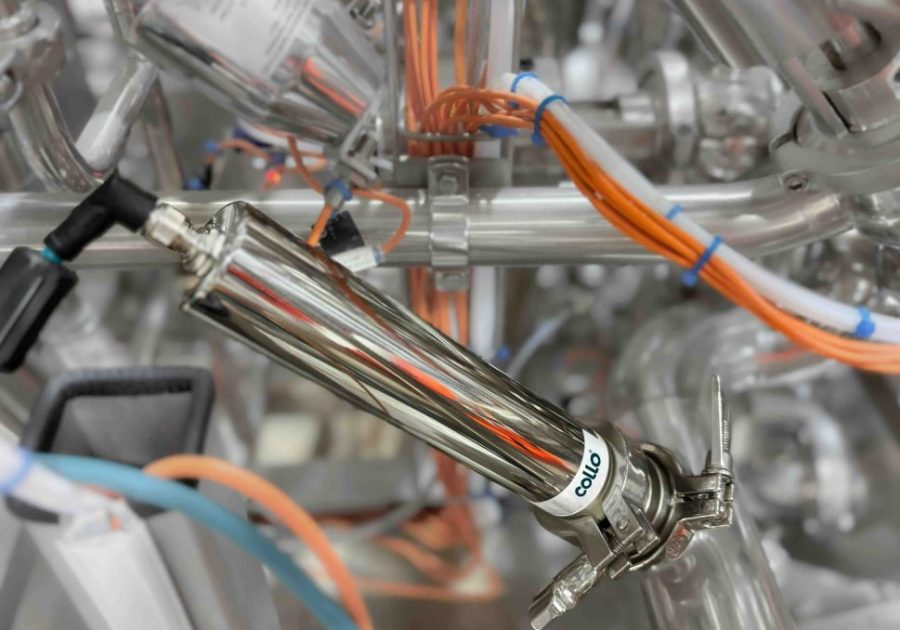
Valio implemented Collo analysers on its cream processing line. The inline analyser detected the exact moment when water transitioned to cream, replacing guesswork with certainty. This precision delivered results on both fronts: less product sent to drain and no water contamination compromising batch quality. The faster, more accurate changeovers also reclaimed valuable production time. Capacity was gained without expanding infrastructure or increasing resource consumption.
Case Study: European beverage manufacturer
A large-scale European beverage manufacturer implemented Collo analysers to optimise CIP operations. The existing protocols were based on fixed time intervals designed for worst-case conditions, which was reliable but resource-intensive.
Collo’s inline analysers provided real-time visibility into rinse water quality and chemical concentration levels. When rinse water reached acceptable purity, the system signalled completion, regardless of whether the predetermined time had elapsed.
Real-time optimisation reduced CIP cycles by 23 per cent. The shorter cycles also reclaimed production capacity. The facility achieved sustainability improvements while boosting operational efficiency.
The broader implications
These examples demonstrate a fundamental shift in how dairy manufacturers can approach sustainability. Rather than viewing environmental responsibility as a cost centre, real-time liquid process intelligence enables plants to reduce environmental impact while improving operational performance.
When facilities produce more from existing infrastructure, without additional energy consumption, water usage, or physical expansion, they achieve genuine resource efficiency. As carbon taxation under the EU Green Deal potentially costs non-efficient plants €50,000 to €250,000 annually, technologies delivering measurable results provide a clear path forward.
In an industry where one per cent raw milk loss can cost over €2.6 million annually, seeing clearly is the first step towards operating better. When traditional monitoring tools leave one guessing, real-time liquid process intelligence provides certainty, and certainty can translate directly to competitive advantage.
For more information, visit www.collo.fi.