Looking at smaller dairies with Jongia

Jaap de Jonge. Credit: Neil McRitchie, Bell Publishing
Jaap de Jonge, owner of Jongia (UK) Ltd, a company that represents European companies, was on hand at the Dairy Industries Expo to discuss smaller dairies and how they may either grow or fail, but cannot stand still. “Grow, you can’t stay small. The dairies that succeed are the ones that grow. Standing still is dying. That is easier said than done, but it is the way. Those with plans and enthusiasm are the ones that succeed,” he noted, having been in the industry for the past 25 years.
He observed that there are many stories of cheese makers who did well and others who have folded. “Here in the UK (as in other countries), the small dairies are facing these issues. The higher staffing costs, legislation and so forth makes running a dairy much more complicated for the few people in it. If a dairy processes 10,000 litres per day with 20 or so people, you have more automated dairies doing 100,000 litres with a similar number. Some specialist dairies can still get away with it, such as Cropwell Bishop, the famous Stilton maker. However, there are limits to everything and with Tuxford & Tebbutt closing last year, it is clear that the producers of the ‘queen’ of British cheese are not immune from the market forces,” he warned. “Reduced spending power makes customers trade down and the specialists get often squeezed. Artisan cheeses can easily retail for over £30 (€34.11) per kilogram. That is not nothing. Compare that to a Waitrose Duchy Organic for just over £10 (€11.37) per kilogram. You need an excellent story to get that premium.”
There are also many types of success stories, he stated. “Carron Lodge has developed into a major distributor, besides making cheese. Butlers has bought up other smaller dairies, Shepherd Purse is where the sisters Caroline and Katie run the dairy their mother started and are taking it to new heights.”
Jongia does tend to supply cheese makers in the smaller to medium-range markets – one million litres and lower per day. “The suppliers in our offering are family companies and we tend to supply family companies.”
Although he is not a supplier of Müller of Germany, he cited them as a successful family company. Theo Müller owns the firm, which had a turnover of €9.5 billion in 2024. “He inherited the company in 1971 with only four employees. The four person business can go either of two ways. It does not stay four persons for long. It either grows, or it fails. Of course we never know what exactly happens behind closed doors, but I speak to many business owners who closed,” de Jonge observed.
“Meanwhile, around 20 years ago a mother and son had a dream. They started a cheese making operation in a room on a farm on the Isle of Wight. Now they own the farm and started a project that includes a much larger dairy, restaurant, shop and outdoor activities, which will make this farm a must-see destination on the island,” he added.
That being said, he mused, “the sad thing is, in the closing cases, there was no business to sell. The door gets shut for the last time and the equipment sold. Why is it that most dairies have no business to sell? Only in rare occasions does a dairy gets sold as a going concern – Sharpham Dairy comes to mind. I was told that in one dairies case, the largest creditor was the farmer who sold the dairy the milk and then took the dairy over. That made sense to me.
“When a dairy closes, when it has no family members interested to take it further, the business just folds. When a dairy sees that the business is not making money, most close before they get into financial trouble.”
Businesses are about reputation as much as product, de Jonge states. “I once talked to a serial entrepreneur who said I had no business to sell. It’s all in my head. That is true. He built businesses, had personnel and a building and sold them. However, many of these dairies do have all of that as well, and they still have don’t have a business to sell. I understand that many are in rented premises, but they have brand names, customers, equipment and a reputation built over many years. Then suddenly, when the cheese maker does not want to continue, it just stops like a tire with a puncture, and years of hard work just disappears.”
He offered some advice on how to avoid this issue:
1. “Keep an eye on your purchases. Check regularly if you buy the best products for the best prices. Profit is not only generated by selling at a high price, but buying competitively also helps the bottom line.
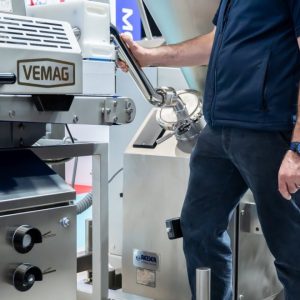
2. “Check automation. It is often more affordable than you think. The fixed weight cutter does 30-40 cuts/minute. That is difficult to do with a human. The machines doesn’t get ill and does not need a holiday. And it reduces give away. It earns itself back quickly, if you use it enough. The machine on-stand at the Expo was the second one for Savencia. They agreed with another customer that it was a ‘no brainer.’”
3. Buy in services. “Sometimes it is cheaper to contract out than to do everything in house. One cheese maker used another cheese maker for contract cutting. This was a win-win for both. The machine was used more and he got some extra income while the other one had a fixed weight without the need to invest immediately.”
4. Grow – you can’t stay small.
Jongia (UK) Ltd. shared a stand with Facchinetti of Italy, manufacturers of fixed weight cutting equipment. Also on the stand was Brunner Anliker, a Swiss company making grating equipment. Jongia represents ASTA foodtec, a German manufacturer of dairy equipment such as pasteurisers, cheese vats, butter churns and the like. Also from Germany is Schmid Folien, a manufacturer of cheese wrapping, such as the wrap for Camembert style and aluminium foil for blue cheese.