Bubbling up fast
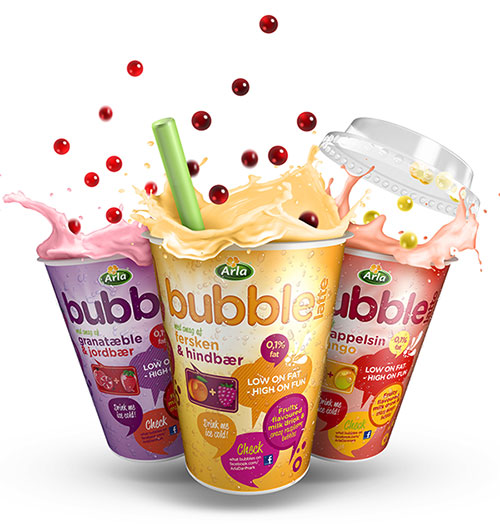
By involving teenagers from the start, Arla Foods hopes that its Bubble Latte will capture the youth market in Europe, Julian Melletin of New Nutrition Business reports
Bubble tea, a massively popular drink among teens in Asia and now a global trend, consists of a tea base mixed with fruit or milk. What makes it particularly appealing to younger drinkers is that it contains chewy balls (usually made of tapioca) that are sucked up through a large straw.
When Arla Foods product developers saw bubble tea in a café in Denmark, they knew they were on to something – and the resulting product, called Bubble Latte, is a role model of how to go about creating a genuine innovation. “[We] found it really fun, and quickly started thinking that this might be a great thing to match with milk – that is, to exchange the tea with a fruity flavored milk,” says Gitte Buje, commercial innovation manager at Arla Foods.
Having realized the potential of the drink, Arla Foods made several key decisions about how it would execute the product, which is being piloted through 7-Eleven stores in Denmark:
• It would involve the target audience – teenagers – in the development of the product and its marketing
• It would make the most of a small marketing budget by using a fun social marketing campaign
• Only natural ingredients would be used.
Says Buje: “We made some internal tests using the bubbles we could get in our local tea shop, and the experience was so great that we decided to take it one step further by inviting the target audience we saw for the products – teens and young adults – to co-create on the project. We kept involving more groups of teens as we went along in the project and got loads of feedback and ideas through that process.
“We were also really lucky to find a supplier who could provide us with bubbles made from natural ingredients – and from that moment we were seriously on the way to the kind of product we would like to make: a product which combines all the goodness of milk with the crazy, fun element of the bubbles – using only natural ingredients.”
Bubble Latte is a low-fat (0.1% fat) milk-based drink with a mild fruity flavour, which contains chewy balls made of seaweed (alginate), with fruit juice inside. Arla Foods believes it’s first in the world to launch a retail product where milk and fruit bubbles are combined in one product. Billed as “Low in fat, high in fun,” the drinks sell for DKK21.95 (€2.95) and come in three flavours.
The pilot runs till December, and if it’s successful, Buje says Arla Foods intends to go for a wider distribution.”We also have quite a few ideas for new flavours that we would love to put on the shelves in the near future,” she notes.
Teens are a notoriously fickle audience with tastes that can be hard to predict – which is exactly why Arla Foods chose a co-creation process.
“We have seen so many attempts in a lot of categories trying to reach a teen audience but failing completely – because as adults we think we know what they want – but their likes and dislikes are so dynamic that we often miss,” explains Buje. “Also in terms of tone of voice where the teens call it ‘adults trying to be teens’ and seeing right through it.”
Arla Foods comments: “Activating teens is not about classic media push, it is definitely a lot about involvement. On a small budget we have created a campaign with a big reach in the target audience.”
Arla Foods has taken the original bubble tea inspiration and adapted it to be milk-based and to better appeal to the tastebuds of its target market. “Some of the products from Asia are a bit too far away from our taste palates and food culture in Europe,” explains Buje. “But there are definitely interesting things going on in Asia that we can learn from and be inspired by,” she adds.
Another important aspect of the product for Arla Foods to adapt was its naturalness. The company has a consumer promise around “Closer to Nature,” which means it is committed to supplying products using natural ingredients. “For us it is not really a choice,” Buje says. “We were lucky to find a supplier that could deliver the bubbles we needed. In our choice of fruit flavours for our milk base we have gone for carotene, which is from the yellow in carrots, and betanine, from the red in beetroots.”
Asian inspiration
The food and beverage industry has been driven to a surprising extent by innovations that originated in Asia. Probiotic yogurts (originating in Japan), energy drinks (Red Bull originated in Thailand), tea both green and black and many other success stories originated in Asia.
Bubble tea is the latest Asian import that is gaining ground. Debuting in Taiwan in 1980s, today major urban centres in most western countries have Asian cafes serving bubble tea, often in cups with plastic dome-shaped lids. The lid is pierced with an oversized straw large enough to allow the pearls to pass through. It’s also a concept that’s known to urban females aged 15-25, who are the core consumers, but unknown to anyone over the age of 35.
Embracing such new and innovative ideas and translating them into the marketplace requires courage. Arla Foods has shown despite being a giant company and not an entrepreneur, it has both in abundance. It is only the companies who embrace both who will be the winners of the next decade.