Where medicine meets dairy
Dairy companies need to look outside traditional channels to medical nutrition for future growth. Julian Mellentin investigates.
Dairy has long been the “most credible” source of nutrition for children, with a positive, all natural identity in the minds of parents. Recent years have seen most of the dairy industry back away from adding science-based ingredients to children’s dairy products – notably omega-3 – and focus instead on clean label and emphasizing natural health. But this leaves the problem of how to innovate.
Fortunately there are two clear directions available for product developers and we can see both of them being followed by Danone-owned kids brands in the US:
• One of them is low risk, provides better margins than many other product types and is likely to grow rapidly in Europe. The only challenge is that it is something that competitors can easily follow with “me-too” products.
• The other is higher risk and lower volume but it offers the possibility of creating strongly differentiated products, based on science, that will attract loyal customers willing to pay premium prices and committed to buying them over and again. It will create strong, high-margin niches and open the door to new distribution channels beyond the supermarket.
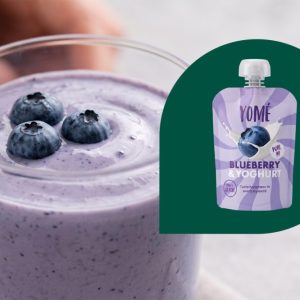
The lower risk, higher volume opportunity is making more use of the on-the-go pouch packs that have enabled makers of kids’ foods to create new segments and categories. It’s a packaging format that has delivered huge success for kids’ brands as diverse as the Ella’s Kitchen kids food brand in the UK and Sweden and the French-owned group Materne, whose business is international and now runs into hundreds of millions in sales. But this spearhead has been in fruit-based products. Only now is the dairy industry beginning to embrace the possibilities of the squeezable, stand-up pouch pack.
In the US Danone has launched Stonyfield Farm Organic Yogurt Pouches, resulting directly from Danone’s acquisition in 2013 of the Happy Family brand in US – and the establishment of a relationship between that company and Stonyfield, of which Danone has owned 85% for more than a decade.
Happy Family has grown into the fourth-largest player in the entire US baby-food market by 2012, with a 4% share and sales of over $60 million (€47.7m).
The Organic Yogurt pouches were only possible because Happy Family brought its own pouch technology to Stonyfield, which applied the packaging to its YoTot, YoBaby and YoKids Squeeze, yogurt lines.
“It’s the same sort of disruption in a different category that we brought to baby food,” says Shazi Vizram, founder of Happy Family. “It’s a premium container with a premium product inside, but kids don’t need a spoon to eat it. And one of the things that Danone Dairy is focused on is creating a bigger experience in yogurt for Americans.”
With pouches gaining ground in Australia and the US, the window of opportunity is now open in Europe.
High end
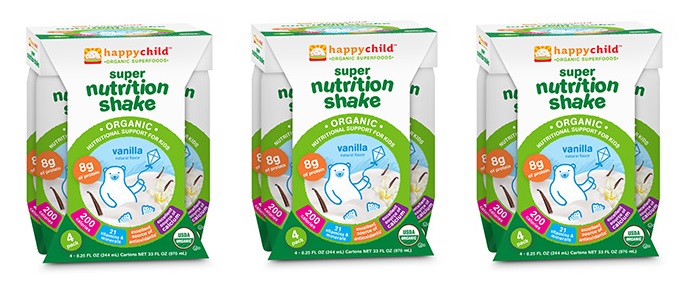
The second opportunity can be found in the many premium niches that exist in the kids market. One example of this is the recent launch by Happy Child of Super Nutrition shakes. The dairy-based shakes aimed at satisfying the intense nutritional needs of children with developmental or medical conditions, such as autism. Each 8.25oz (243ml) aseptic shake, based on organic brown-rice syrup and organic milk-protein concentrate, has 8g of protein and 21 vitamins and minerals. Happy Child Super Nutrition shakes yield 3g of fibre per serving thanks to the presence of inulin and fruit and vegetable powders.
At a suggested retail price of $10.99 (€8.74) for a four-pack, the shakes are aimed at a more intense nutritional regimen. But parents of young children with medical needs are willing to spend to support the health of their children.
Distribution of such a product is through drugstores, pharmacies and the increasingly important online channel – not through supermarkets. The volumes involved are much lower than a supermarket would tolerate (hence the need for alternative channels) but margins are higher and customers are loyal. These channels are also important to give the product credibility.
Essentially a medical food, the small – but growing – cohort of parents whose children have special medical needs are not being offered such products at present by the dairy industry. In Europe there are many regulatory challenges to communicating the benefits to such families, but as medical foods sold in specialized channels, the potential for communication is much higher.
There are some countries where it will not be possible to get the selling price of these products reimbursed under health insurance – but to motivated parents, anxious to do the best for their children, that is not an obstacle. As with many premium products, the best way to distribute is to focus on major urban centres, where there is the critical mass of people with higher incomes.
These are opportunities that can be market-tested at fairly low risk. There are a wealth of contract manufacturers able to produce such products at low volumes if your own production is not geared to such a market.