Cheese to please
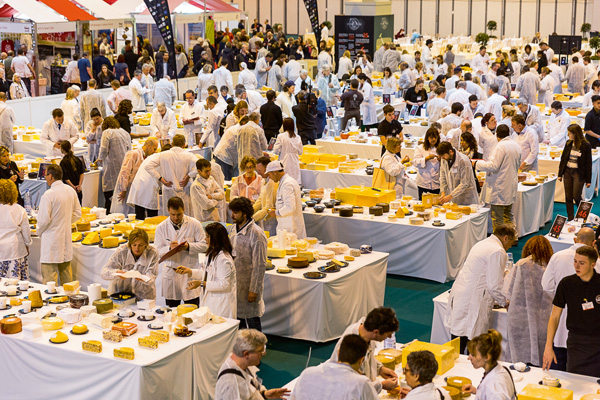
When you walk into the World Cheese Awards arena, situated in the hangar-like structure of the NEC Birmingham, you are surrounded by cheese of all shapes and sizes arranged on 62 tables.
This is an enjoyable occasion, a meeting of the international cheese judging fraternity and professionally stimulating. Cheeses displayed – all 2,727 of them, represent many cheese producing countries that would not get this opportunity if it were not for the time-consuming attention to detail of the WCA team. Ten points of consolidation, by plane, train and ship, transport cheeses from South Africa, Australia, the US, Canada, and across Europe, presented meticulously in their classes.
In his introduction, John Farrand chair of the Awards, and of the UK Guild of Fine Food, welcomed everyone, including some new young judges aged 14,16 and 18. “Our trade needs younger people,” Farrand says. “Sometimes I am the youngest in the room.”
For judges whose experience, enthusiasm and maturity are their trademark, a little shiver of fear went down the collective backbone.
The WCA procedure is to offer each team of four judges a table of mixed classes, with different milks. Some are processed and some contain additives. Gold, silver and bronze medals are awarded to cheeses with minor or no faults. The outstanding cheese on the table is a Super Gold, which goes on to be considered by the Supreme judging team.
The team on Table 58 included a Somerset Cheddar producer; a Canadian cheese maker; a specialist retailer from Yorkshire and myself. It took us a bit of time to assess the different tastes and strengths, leaving the blues till later, starting off with a selection of international ewe’s milk cheese.
Tastebuds attuned, we enjoyed the variety of textures and maturity, looking for the wow factor of a potential gold medal. Unexpectedly this came in the form of a cooked (on the premises) Cypriot halloumi complete with traditional mint leaf within. It was deliciously fresh.
We eventually awarded this our super gold. Since the results were published, I have found out it was made by family dairy Polycarpou, in the village of Prastio near Limassol. The details of its traditional recipe and the warmth of its pastures brought sunny Cyprus to rainy Birmingham. It is no stranger to gold medals however, having collected them at the International Cheese Awards, and the Frome Global awards already.
We looked forward, especially our Canadian colleague to the class of Creamery Cheddar described as extra mature, having been made before May 2014. These were disappointing, with a lack of mature flavour in texture or complexity, but represented the trend for sweeter flavoured cheddar for consumers buying in supermarkets.
The eventual gold (half the class judged on another table) was Arla (Taw Valley) with a US Cheddar from Promontory with silver, and a Canadian bronze. Dairy Crest (Davidstow) also won a gold in this class.
Super gold blues included Peakdale Blue Stilton from Cropwell Bishop; Montognolo affiné – a former WCA and ICA Supreme champion; Tarwin blue from Australia and Reserve Blue from Saputo, US. The super gold concept means there are 62 exceptional cheeses to be whittled down by the Supreme judging panel to the last 16, one of which is championed by each judge and tasted publicly. After extolling its merits each cheese is marked out of five points, which produces the overall Supreme Champion.
Watched by a sizeable crowd, and recorded by TV and radio, the panel from 13 different countries voted for the World Champion cheese, a Gruyère AOP Premier Cru produced by René Ruch of Cremo SA. This was entered by well-respected affineur Walo von Muhlehen, who has won this accolade himself. Von Muhlehen for Switzerland had three cheeses in the top 16.
Only one point separated the worthy winner, and tied for second place were a French Tomme chevre/brebis from Onetik, and a Burrata from La Credenza, UK/Italy.
In the evening a very convivial Judges’ dinner was held, in the course of which thanks were recorded to all the sponsors of the WCA and the hard work of the Guild of Fine Food staff. The 2016 Awards will be held next November (16-19) in Donostia-San Sebastian, celebrating the cheese producers of the Basque country, by being part of their International Cheese Festival.
One highlight of the dinner, a fitting culmination to this year’s awards was a presentation for the “Exceptional contribution to Cheese.”
Bob Farrand, founder of the Awards, says, “It gives me great pleasure to present this to a real live cheese maker, one of the ‘livest’ of wires. You can take the girl out of Devon, but can’t take Devon out of the girl.” At this point the unsuspecting Mary Quicke, of Quickes Traditional twigged. The audience were genuinely delighted, and gave her a standing ovation. Someone remarked afterwards, “This was not a corporate polite reaction, but affectionate appreciation of all she, and her farming family stands for.”
A record year
The World Cheese Awards in Birmingham at the NEC in Birmingham, UK hit records this year with 2,727 cheeses on the tables ready for judging. And what a collection it was – cheeses came from more than 30 countries, and 25 per cent hailed from the UK and Ireland.
One of the more interesting things about this particular awards is the amount of cheesemongers helping to do the judging. They’re very useful in that they strike a balance between what the public wants and what cheese experts think is the best cheese. Their insights quite spot-on when on a judging team with them. They are always very welcoming to the hacks that buzz about them, trying to eat more Caerphilly before judging ends and the beautiful cheese is taken away.
John Farrand, the director of the Guild of Fine Foods, noted this year that there were three young people helping to judge cheeses, one as young as 14. One of them, Izzy Jones is an articulate woman and an ardent fan of cheese. She also is learning tremendous amounts by being at such events, she notes.
John Farrand says young people are the future of our industry, and of course he is right. They will sell the cheeses that the makers work so hard to produce, and the more they know the better. – Suzanne Christiansen
TopicsOrganisationsRegions