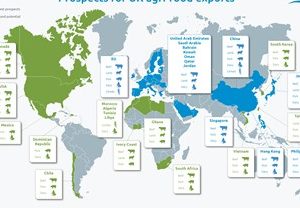
Germany’s export markets in 2016/17
Export was difficult for the German dairy industry in 2016, according to Germany’s Export-Union für Milchprodukte. In all product segments, large fluctuations in volume and price developments were seen, it says. However, there were some bright spots.
Cheese saw its 2015 total increase by about 8,000 tons, to 1.18 million tons. This was 0.7% higher than 2015’s figures and also a new record. The pricing, which was lower in the first half of 2016, stabilised in the second half.
It depended on the cheese as well. Varieties such as Bergkäse/Appenzeller were able to significantly improve prices in December, but only half of the quantity was exported compared to 2015. Edamer, Tilsiter, Maasdamer and Gouda achieved 30-40% higher prices in December, but with a simultaneous decline in export volumes.
Exports of cheese to EU neighbours fell after a good first half-year and were just below the 2015 result (-1.24%). Within the EU, the Netherlands (-5.3%) as well as the UK (-2.3%) and France (-2.1%) purchased fewer German cheeses.
Stronger demand from Hungary (17.9%) and Poland (6.2%) could not compensate for this decline, as total volumes were low. However, the Netherlands remains the second most important export country for German cheese after Italy.
Cheese exported to third countries saw big improvements of 18.5%. The four main destinations were Switzerland, Japan, the US and South Korea. In 2016 German dairies were able to sell around half of the cheese produced (2.4 million tons) abroad, of which about 10% went to third countries.
In the butter segment, the ratio between export price and export volume also reversed during the year. In December about 12% less butter was sold, but the price for this product was an average of 30% above the previous year.
Butter exports, especially Iran, the US, Japan, Saudi Arabia and South Korea, are proving interesting. Exports to Iran have developed quite positively over the last few years, but 2,500 tons exported in 2016 is still lower than in 2010.
Overall there was a 4.7% drop in butter exports compared to 2015. Around 27% more was sold in non-EU countries, so that a little more than 15,500 tons of German butter are sold outside the EU. The lion’s share of German butter exports in 2016 – 117,000 tons – were sold within the EU. However, here demand fell by almost 8%. Germany produced around 516,000 tons of butter in 2016, so a quarter therefore went to export, but only 3% of production went to third countries.
Butter production in the EU as a whole rose by 2.5 % or over 50,000 tons in 2016, whereas in Germany it declined slightly (-0.22 %).
In 2016 China purchased about 213,000 tons of packaged milk (+ 1.6 %) from Germany, which corresponds to about 4% of the consumer milk produced in Germany. As a result, China is the most important customer in this segment and has even overtaken the Netherlands (200,000 tons) as top purchaser of drinking milk.
In the whole of 2016 around one million tons milk and cream in small packs (-2.7%) were exported, and almost 350,000 tons went to third countries (an 8.5 % increase).
Both condensed milk, whole milk and whey powder as well as casein and caseinate were exported less in 2016 than in the previous year, while skimmed milk powder exports remained stable. Only the exports of lactose increased.
In the first two months of 2017, the export prospects for the German dairies on the world market were somewhat diminished. High German prices for milkfat had a negative impact on the export of butter to third countries, and even more difficult was the export of cheese.